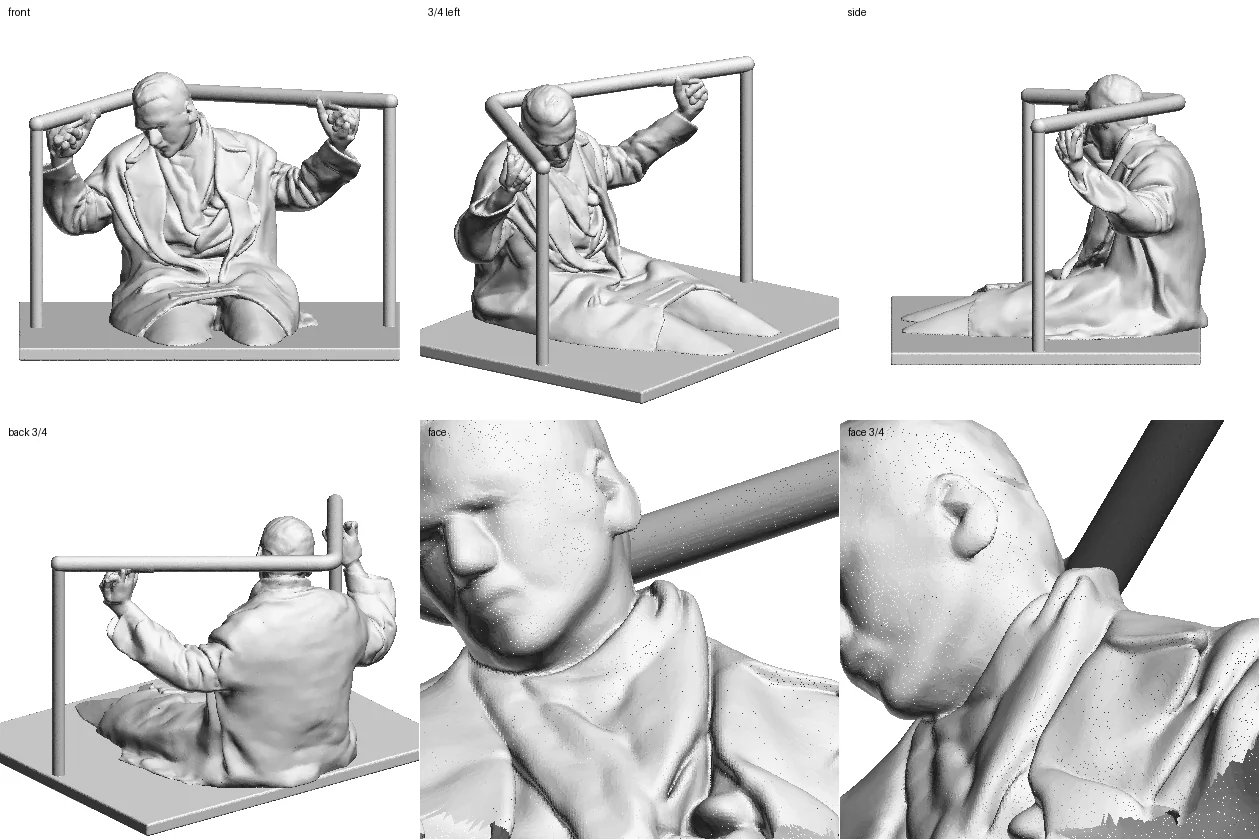
Damiel at the Railing
A printable Damiel from Wings of Desire, built from a single frame of the film.
Free · watertight, single body
In Wim Wenders’ Wings of Desire (1987), the angel Damiel, played by Bruno Ganz, sits on the floor of the Berlin State Library in the corner of a railing, his hands raised to the bar. This is that moment as an object you can print. It started as a single frame of the film, and an image-to-3D model gave it a body. Everything that makes it printable came after: the rail, the grip, the head and the hands were all rebuilt as a distance field until the whole thing closed into one solid.
Printing
- Size
- — 177 × 147 × 120 mm, about 540 cm³. Fits a 256 mm bed (Bambu A1) with room to spare.
- Mesh
- — One body, watertight, 386k triangles, binary STL. It reloads watertight with no repair pass.
- Detail
- — The head is about 28 mm tall and the hands about 15 mm, close to the limit of an FDM nozzle. A resin printer, or scaling up, will hold the face better.
How it was made
- One frame — Taken at 9.5 seconds into the library scene, where Damiel sits in the corner of the railing with both hands up on the bar. Background removed with BiRefNet.
- Image to mesh — Hunyuan3D 2.1 turned the frame into a full-body mesh. The head and the right hand were generated again as separate close-ups for more detail. Every attempt at the left hand failed, so it is a mirror of the right.
- Mesh to distance field — The AI mesh is full of gaps, so it is never used as a surface. Inside and outside are decided by a fast winding number, which tolerates holes, then turned into an exact signed distance on a 0.33 mm grid.
- Edits in the field — The arms are sheared back to meet a straight rail. The head and hands are grafted in by blending distance fields. The rail is rebuilt as a 95.7° corner with a filleted bend and unioned with the hands as one smooth shape, so the grip doesn't sawtooth. Posts and base are exact geometry, and stray islands and voids are cleaned out.
- Export — Marching cubes, then a manifold-preserving simplify, then coincident vertices nudged 0.01 mm apart so the STL reloads watertight.
The first attempt
Before the image-to-3D route, the scene was trained into a Gaussian splat. It orbits beautifully, as above, but the camera in the shot barely moves, so the splat only knows Damiel from the front. Every attempt to turn it into a solid, whether from the splat’s density, from fused depth, or from COLMAP stereo, came out as streaks and spikes.

A fan work. Wings of Desire (Der Himmel über Berlin) is by Wim Wenders, 1987. This figure is not affiliated with or endorsed by the filmmakers.